Webflow vs a site you own
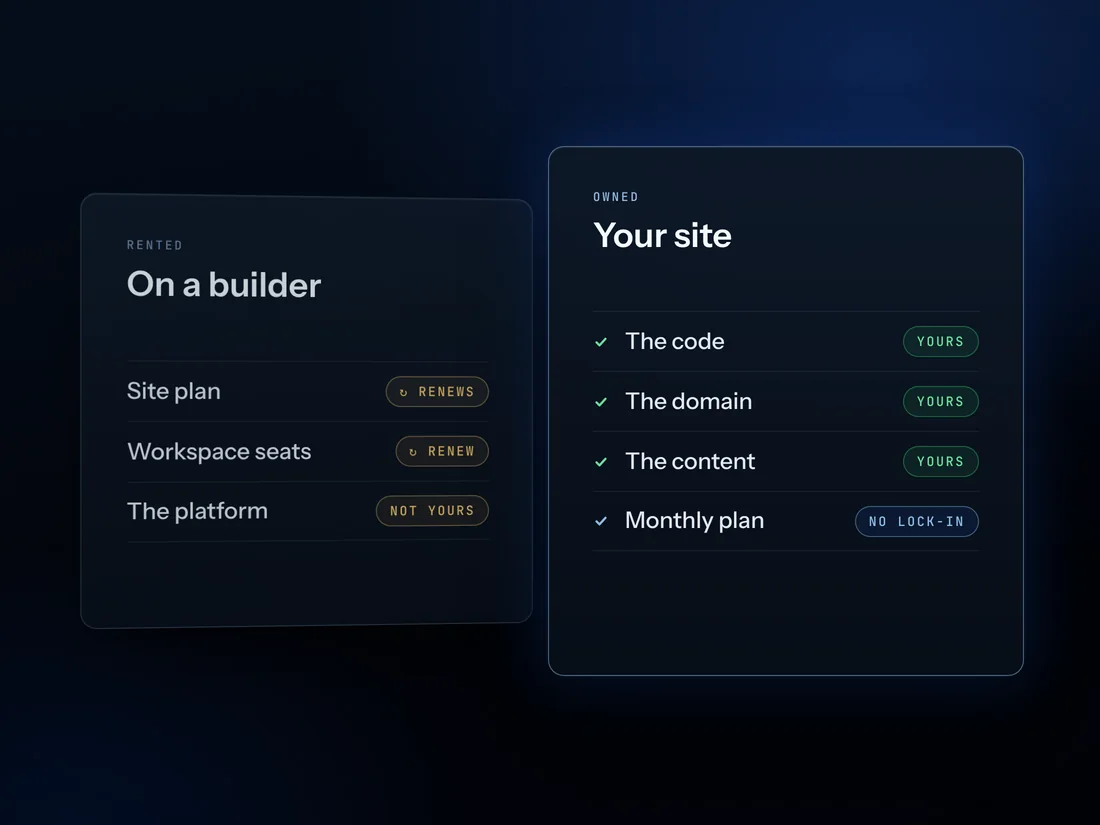
Webflow is a genuinely good product and rarely the right long-term home for a site your business depends on. You rent it (per site and per seat, every month, permanently), and the export button hands you a snapshot rather than a working website.
What Webflow is genuinely good at
Almost everything written on this subject is written by people selling the alternative. I sell the alternative. So let me start with what Webflow does better than we do, because if one of these is your situation you should use it and I will say so on the call.
- A non-developer can change the design, not just the text. That is rarer than it sounds and it is the entire product.
- Hosting, CDN, SSL and backups are included, and you never think about any of them again.
- It ships fast. A marketing team that publishes a new landing page every week does not want to wait on anyone.
- The CMS is good enough for what most marketing sites need: collections, references, a usable editor.
- Nothing to patch. No plugin has ever taken a Webflow site down at two in the morning, which is more than WordPress can say.
One: the subscription never ends
Webflow bills in two directions: a site plan to keep each site online, and a workspace seat for each person allowed to edit it. Both are monthly, both are permanent, and neither is under your control: the price is set by a company whose plans have been restructured more than once since 2019. Over three or four years the subscription is routinely a larger number than the build was.
That is a fair deal for an office. It is a strange one for the asset that produces your leads. And the day the card is declined, the site does not degrade or go read-only. It goes off.
Two: the export is a dead end
On the higher plans Webflow lets you export your site as HTML, CSS and JavaScript, which sounds exactly like ownership until you open the zip. CMS content does not come with it: collections arrive as baked-out pages and the editor that produced them stays behind. Forms stop working, because they were posting to Webflow. Anything that leaned on Webflow’s own runtime is a static file now.
What you are holding is a photograph of a website. It can be hosted anywhere and maintained nowhere. Adding a single page means going back to Webflow or rebuilding from scratch. The test worth applying to any platform is simple: can another developer take this on Monday and ship a new page on Tuesday? For an exported Webflow site the honest answer is that they would rather rebuild it, and they will quote you for exactly that.
Three: the ceiling on performance and SEO
You can build a fast Webflow site, and plenty of people do. What you cannot do is control the things that set the ceiling: the markup a visual builder emits, the order scripts load in, what is rendered on the server versus assembled in the visitor’s browser, and how images are processed on the way out. Every feature that is not native (booking, chat, reviews, a slightly unusual form) arrives as one more third-party script, and each one is charged against the metrics Google measures on real visits.
I know this from our own work: our first client sites (DMD Technics, Sra Glow and Magnus Plus) were built in Webflow and still run on it. I am not claiming a builder cannot do better. I am saying that on a code-owned build the ceiling is a decision we make, and on a builder it is a negotiation with somebody else’s output, one you have to win again every time a feature is added.
The honest counter-argument: we charge a subscription too
Our monthly plans start at €39 for hosting, security and backups alone, and from €99 add your numbers in a portal (coming soon) and a set number of changes each month. That is a subscription, and pretending otherwise would be dishonest. The difference is what it buys and what happens when it stops. The code, the domain and the content are yours once the project is paid, so cancelling means we hand them over and you carry on somewhere else. Nothing switches off. A platform fee buys permission to keep using your site. A service fee buys work. Those are not the same line even when the amount matches.
When each is the right call
| Choose | When |
|---|---|
| Webflow | You have a marketing person who redesigns pages weekly and no developer to wait for. |
| Webflow | It is a campaign, an event or a launch site with a life measured in months. |
| Webflow | You are pre-revenue and you already know you will rebuild once you know what you are selling. |
| A site you own | The site is a revenue channel, and slowness or downtime costs you real money. |
| A site you own | Something real has to be wired in: booking, ordering, a CRM, payments, a calendar. |
| A site you own | You intend to keep it three years or more and would rather own an asset than a login. |
| A site you own | You want to be able to hire any developer, not a developer who happens to know one platform. |
We build in code: Next.js, hosted and run by us, owned by you. Not because builders are bad software; they are not. Because what a client is actually buying is a business asset, and an asset you cannot take with you is a rental with better branding.