What “code-owned” actually means
Code-owned means that on the day you decide to leave, you can hand the repository, the domain, the content and the accounts to another developer and they can run your site without asking us for anything. No licence, no export, no permission.
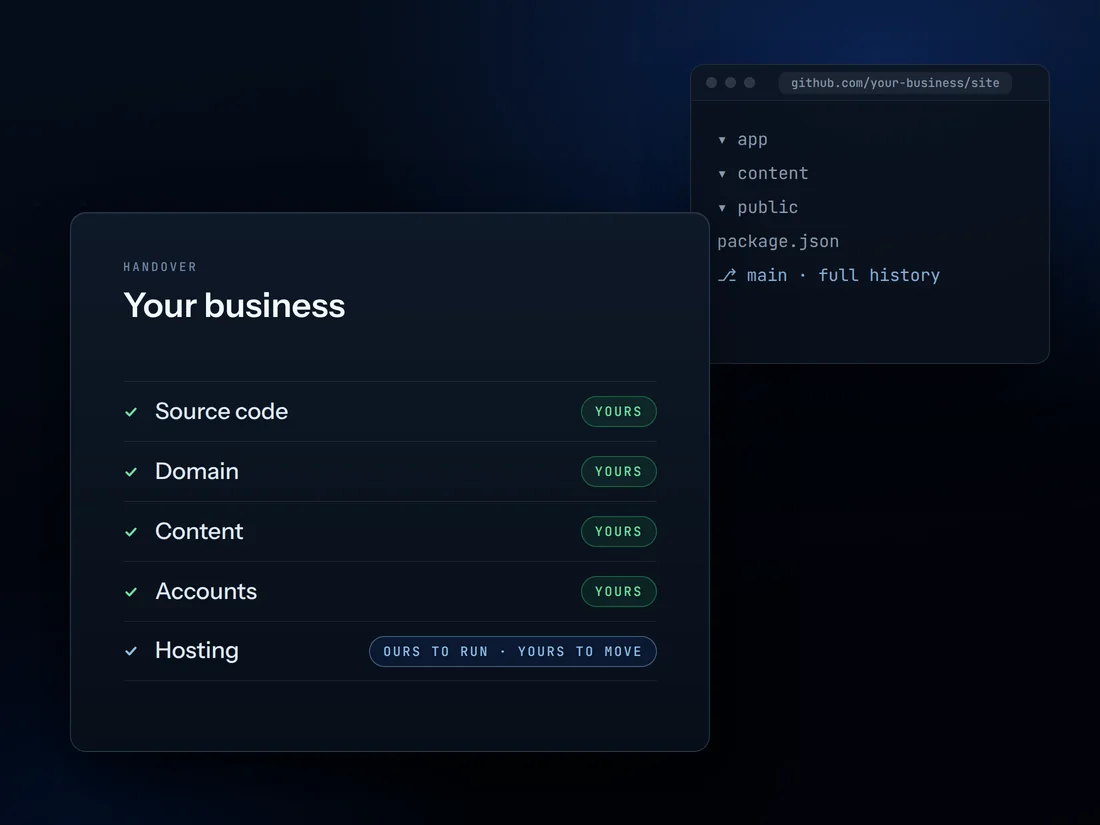
“You own your website” is on almost every studio’s page, and most of the time it means you own the design. Ownership is not one thing. It is five things, each of them an account with somebody’s name on it, and the only way to know what you are buying is to ask about all five separately.
The five things, and who owns them
| What | Where it lives | Whose |
|---|---|---|
| The source code | A private Git repository on GitHub | Yours once the project is paid. We keep it for you and hand it over, with its full history, whenever you ask. |
| The domain | Your registrar, or ours if you had none | Yours. One you already have stays at your registrar and we only set up the DNS. One we register for you is renewed under your plan and transferred to you whenever you ask. |
| The hosting | Cloudflare, run by us under the monthly plan | Ours to operate, yours to move. It is a standard Next.js app: any host that runs Node will take it. |
| The content | In the code; from Authority up, in a CMS with an export | Yours. Text and images come out in a format another system can read. |
| The accounts | Analytics, booking, mail, payments | Yours, on your card, with you as owner and us added as a user. |
Notice that only one row is ours, and it is the one you are paying us to operate. That is the whole design. Nothing on that list needs our cooperation to keep existing.
What you can take on day one
- The full history of the code, not a zip of the final state: every change, with the reason it was made, which is what lets a new developer understand it instead of guessing.
- The design source files: the logo in vector, the palette, the type system and the style guide, in the formats a printer will actually accept.
- The content, in the code or, from Authority up, exported from the CMS and readable by something else.
- The domain: the one you had, still at your registrar, or the one we registered, transferred to you.
- A running site. Another developer clones the repository, runs one install command and has your website on their own laptop. That is the real test of ownership, and it is exactly why we build on a framework thousands of developers already know rather than something clever of our own.
What you cannot take, and why that is fine
- The open-source libraries stay under their own licences. Next.js, React and everything else underneath are free to use and always were. Nobody owns them, including us.
- Our internal tooling. The studio runs its own system for projects, and soon for your portal. That is how we work, not part of what you bought (the same way you do not get an agency’s project software when you leave one).
- Our speed. Ownership means you can hire anyone; it does not mean the next person is instantly as quick. A codebase is only as portable as it is conventional, which is the argument against inventing your own framework and the reason we do not.
What “ownership” usually means elsewhere
None of these are lies. They are all narrower than they sound, and the difference only shows up on the day you want to leave.
- A WordPress install you genuinely own, with twenty-two plugins you cannot update without breaking something. Owned, and unmaintainable.
- A builder site where you own the design and rent the platform. Stop paying and it goes dark, design and all.
- A custom build with the code in the agency’s own account and no written promise to hand it over. Ask what happens if the agency is sold, or simply closes.
- A contract that transfers rights on full payment, which is correct, normal and also what ours says. Transferring rights is not the same as handing over keys. The difference is whether the contract also says when the keys reach you, and what happens if the supplier stops.
Six questions for any supplier
- Whose name is the domain registered in, and can I log in today?
- Where does the source code live, and who owns the account it sits in?
- If I take this to another developer on Monday, what do they need from you?
- What stops working the day I stop paying you?
- Is there a per-site or per-seat fee to a third party, and what is that over three years?
- Can I export the content, and in what format?
A supplier who can answer all six in a sentence each is a supplier you are able to leave. That, and only that, is what ownership is worth.
What it looks like in practice
A domain you already have stays at your registrar, in your name. A domain we register for you sits at our registrar and is renewed under your plan; it is yours once the project is paid, and we transfer it into your name whenever you ask. The repository is yours once the project is paid, and we hand it over, with its history, the day you ask. From Authority up, the CMS has an export button and you have a login. The analytics account has your email as the owner. The monthly plan is billed per month with no lock-in, and our terms say in writing that when a plan stops, even because the studio does, we hand over the code and the domain. It covers hosting, security and backups, and from Steady up your changes too: small ones live within 48 hours, larger ones inside five working days.
Not one item on that list is unusual for a developer. It is unusual on a proposal, and that is the point. We have never needed a clause that makes leaving expensive, because the plan is worth paying for on its own or it is not worth selling.