What a Lighthouse score is actually worth
A Lighthouse score is a lab measurement of one page load on a simulated mid-range phone: an excellent build check and a poor marketing number on its own. The same page can score very differently on desktop and on a throttled phone, and that gap is most of what this article is about.
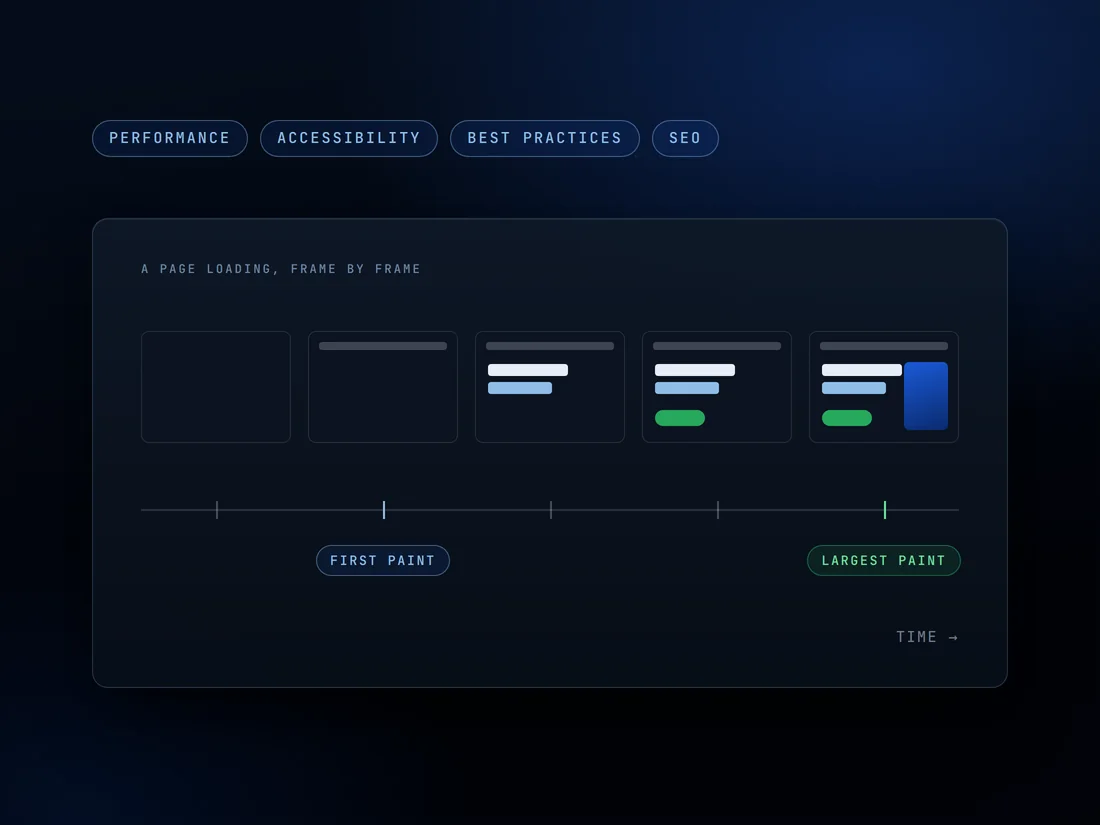
Four scores, and what each one measures
| Score | What it measures | Does a visitor feel it? |
|---|---|---|
| Performance | Lab timings of a single load: how soon something paints, how soon the main image or headline lands, how long the page is blocked by JavaScript, how much the layout jumps while it settles. | Yes. Directly, and within the first second. |
| Accessibility | An automated subset of accessibility rules: contrast, form labels, alt text, heading order, misused ARIA. | Some visitors, completely. It is also the score most often mistaken for a full audit. |
| Best Practices | Hygiene: HTTPS, no console errors, images served at their real aspect ratio, no deprecated browser APIs. | No. It is a signal about whoever built it, not about the visit. |
| SEO | A checklist, not an assessment: does the page have a title and a description, is the text legible, are the links crawlable, is robots.txt valid. | No. It cannot tell whether the content deserves to rank for anything. |
The last row is the one people quote most and understand least. Lighthouse’s SEO audit checks that a page is technically eligible to be found. It has no opinion on whether anybody is searching for what the page says. A site kept out of search on purpose before its launch scores badly on it for exactly that reason: the audit reads a configuration flag, not the quality of the page.
Which of the four a customer actually feels
One and a half. Performance, completely: a slow page is felt as hesitation before it is understood as a delay, and a layout that jumps while it loads is felt as the site being broken. Accessibility, for the visitors it applies to, absolutely: bad contrast on a phone in daylight is not an edge case, it is Tuesday. But the automated checks catch only part of it. Lighthouse cannot tell you whether the site can be used end to end with a keyboard, and a 100 there is the minimum.
Best Practices and SEO are for us: checks a build has to pass before it ships. A customer never feels them, but a 100 on both says the build is technically sound.
Core Web Vitals are a real ranking factor, and a small one
Google uses page experience (Largest Contentful Paint, Cumulative Layout Shift and Interaction to Next Paint) as a ranking signal. Two things about that are constantly misreported. First, it behaves like a tiebreaker rather than a lever: a fast page about nothing does not outrank a slower page that answers the question. Relevance wins, then speed separates the pages that are equally relevant.
Second, and this is the one that matters: Google measures those metrics on real visits from real Chrome users, not on your Lighthouse run. The lab score is a prediction of the field data. It is a good prediction and it is not the thing being measured, which is why a high score on your laptop over fibre means less than it looks. Lighthouse’s mobile test simulates a mid-tier phone on a throttled connection because that is closer to how your buyers actually arrive. Run mobile, or you are grading a different exam.
What we measure, and what it bought
On DMD Technics, a site we built in Webflow, measured in September 2026: the first paint at 0,9 seconds on desktop and nothing blocking the main thread. Desktop is the test that flatters, though. A phone on a throttled connection is what many buyers arrive on, and it is the one we now build against. This site, built in code, measured in October 2026: on a phone it scores 100 on SEO, accessibility and best practices, and on a laptop the main content is on screen in 0,9 seconds.
- 100This site, out of 100 in Google’s test on a phone
- 0,9 sUntil this site is on screen, on a laptop
“We contacted Aktify Studio to build our website and are extremely satisfied. From start to finish, communication was clear and pleasant. Highly recommended! Excellent service!”
Note what the founder does mention: how the project went. What a site earns is the number that counts, and our first sites went live before we tracked enquiries. Ask us how we would measure yours.
The honest limit
A 100 on a site nobody visits is worth exactly nothing. Speed is a multiplier: it makes the traffic you already have convert better, and it removes one reason for Google to put a competitor above you. It multiplies what is there and creates nothing on its own. If a site has no traffic and no argument, the fix is positioning and content, and a perfect score will not touch either of them.
That is why we work in this order: what the site should say, then what it should look like, then how fast it loads. Reverse it and you get a very quick page nobody had a reason to open.
How to read a score somebody shows you
- Ask whether it is the mobile or the desktop run. They are different tests, and mobile is the honest one.
- Ask whether it was measured on the live site or on a staging build with no real content, no analytics and no third-party scripts.
- Ask for the field data (Google’s own Core Web Vitals report on real visitors) if the site has enough traffic for that report to exist.
- Ask what the score was six months after launch, not on launch day.
- Then ask what the site earned. That is the only number on the list your accountant recognises.