What a website costs in Belgium in 2026
A website for a Belgian business costs between roughly €500 and €25.000 in 2026, and the spread has almost nothing to do with how it looks. It is decided by who writes the copy, what has to be wired in behind the page, and whether you end up owning the thing you paid for.
What the Belgian market charges
Nobody publishes this, so here is our read of it. It comes from three places: the quotes clients bring us from other suppliers, what they tell us they paid for the site we are replacing, and what we quote ourselves. Read it as a rough map of the market. A good freelancer and a mediocre agency land in the same band more often than either would like.
| Who builds it | One-off | Monthly after | What you actually get |
|---|---|---|---|
| Freelancer, on a template | €500 – €1.500 | €0 – €30 | A theme with your logo and your text in it. Fast, and it looks like the theme. |
| Template shop or small agency | €1.500 – €4.000 | €30 – €80 | A theme configured properly, on WordPress or a builder, plus a platform fee for as long as the site lives. |
| Custom studio | €3.000 – €10.000 | €75 – €500 | Design and copy written for your offer, built for your business, with a monthly plan on top. |
| Full-service agency | €10.000 – €25.000 | €500 – €2.500 | A team, a project manager, a research phase, and the overhead that pays for all three. |
| Enterprise or serious e-commerce | €25.000+ | Varies | Integrations, several languages, a security review. A roadmap rather than a project. |
Two things in that table matter more than the numbers. The first is that the monthly column beats the one-off column over any realistic lifespan of a site: three years of €80 is €2.880, which reorders most quotes on a desk. The second is that the bands overlap on purpose. What you buy between €3.000 and €10.000 is not more design. It is a different kind of work: somebody deciding what the site should say before anyone decides what it should look like.
What actually moves the price
Six things, roughly in the order they show up in a proposal. If a quote is much cheaper than another one, it is almost always because it is quietly answering these differently.
- Pages. Five pages is a week of design. Twenty-five is a month, and the twenty-fifth page costs about what the first one did.
- Who writes the copy. This is the biggest line nobody quotes for. If you hand over finished text, the build is short. If the studio has to interview you, work out the offer and write it, that is a craft of its own, and it is the part that decides whether the site sells anything.
- What has to be wired in. A contact form is an afternoon. A booking engine that checks availability, takes a deposit, syncs a calendar and sends its own confirmations is a system, and it is priced as one.
- Whether the design is yours. A theme costs a licence. A design made for your offer costs the days it takes to make it, and it is the only version of the two that a competitor cannot buy.
- Languages. Dutch and French is not two extra pages. It is two of everything: copy, SEO, and every change you will ever make afterwards. Our own price: one language is included, a second (English or Dutch) is €50 per page, a change made in both counts as one request, and French is quoted after the call.
- The deadline. A date that cannot move is a scheduling problem, and scheduling problems cost money in every industry.
What cheap costs you eighteen months later
The €900 website is not a scam. It is honestly priced for the first month. Three costs turn up afterwards and none of them are on that invoice.
- The subscription that never ends. Say the builder plan is €40 a month: that is €1.440 over three years, and at the end of it you own a login and no website. The price is also not yours to set: it is set by a platform whose plans have changed several times in the last five years.
- The rebuild. A site that was never built around your offer does not get improved; it gets replaced. Paying twice in two years costs more than paying once, and the second project always starts later than it should have.
- The person who can change it. If only the original builder can touch the site, every future change costs whatever they decide it costs. And if they stop answering their email, you are starting again from a screenshot.
Where Aktify Studio sits
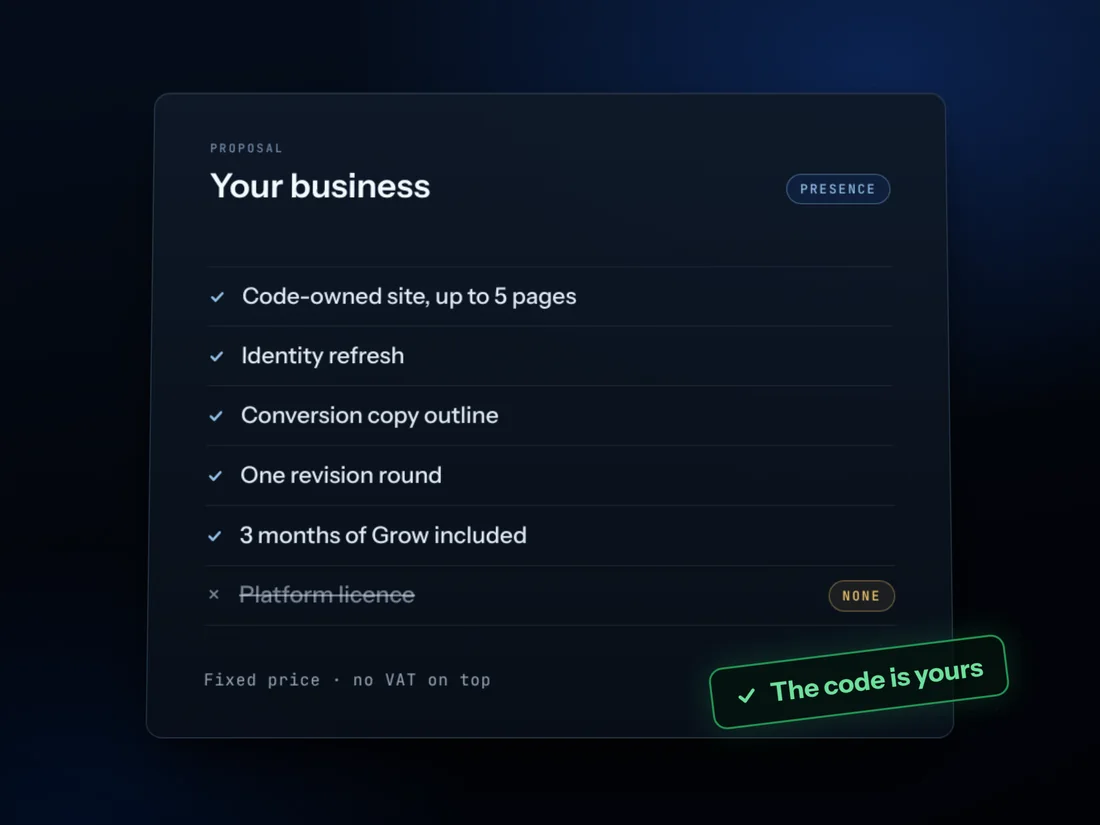
We publish our prices, which in this market is still unusual. Four shapes: a one-page site in code is €749 as Debut, a full site starts at €1.999 as Presence, Authority at €4.499 is the one we recommend for most businesses, and Ecosystem projects run from €8.500 and are scoped on the call rather than guessed at in a table.
- 01DebutOne page, live in five working days.€749
- 02PresenceCredibility, live in 2–3 weeks.€1.999
- 03Authority RecommendedThe full argument, live in 4–6 weeks.€4.499
- 04EcosystemBooking, ordering or CRM systems and custom work, scoped on the call.from €8.500
Monthly plans from €39 / mo
Start your projectAfter launch there is a monthly plan, from €39 to €549 a month. Host at €39 is hosting, security and backups and nothing else; from Steady at €99 you also get your numbers in a portal (coming soon) and a set number of changes per month. It replaces the platform fee rather than adding to it: there is no licence underneath. Three months come with every project: Host with Debut, Grow with the other three, so the first quarter after launch costs nothing on top. And there is no VAT: the studio is VAT-exempt under art. 56bis, so no VAT is added to the price you read.
What that buys, concretely: the code, the domain and the content are yours on full payment. From Steady up, small changes are live within 48 hours and larger ones inside five working days; on Host a small change is €75, and bigger work is quoted first. A second language is €50 per page, and a change made in both counts as one request. Today you ask by email or WhatsApp; the portal is coming soon. Debut goes live in five working days, Presence in two to three weeks, Authority in four to six.
“A massive upgrade for our corporate identity. Aktify Studio understood our complex services and translated them into a clean, professional digital platform. The new site is stable, fast, and perfectly aligned with our vision.”
Five questions before you sign anything
- What stops working the day I stop paying you?
- Whose name is the domain registered in, and can I log in today?
- Who writes the copy, and is that in the scope in writing?
- What does this cost me over three years, monthly fees added up?
- What does a change cost after launch, and how fast does it land?
A supplier who answers all five in a sentence each is a supplier you can leave, and that is worth more than a discount. Price is the easy question anyway. The one worth asking is what the site is supposed to earn, because a €2.000 site that never converts is more expensive than a €6.000 one that books work every week.